

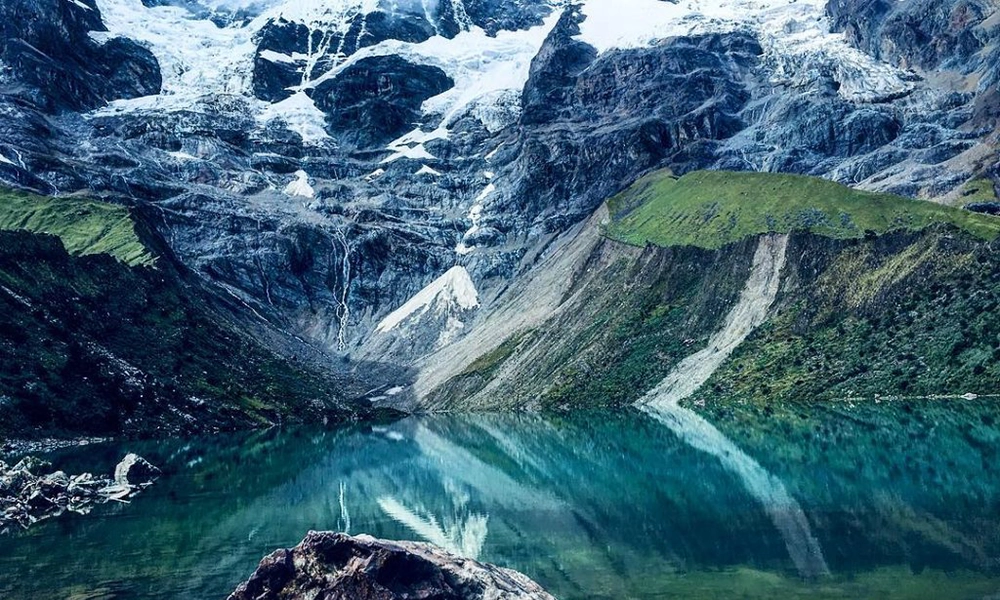
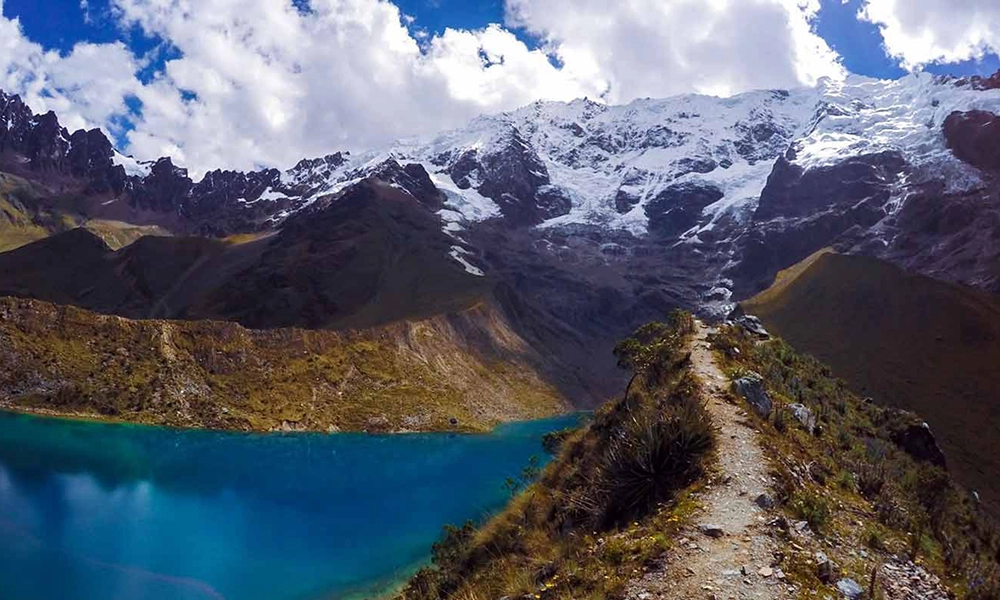
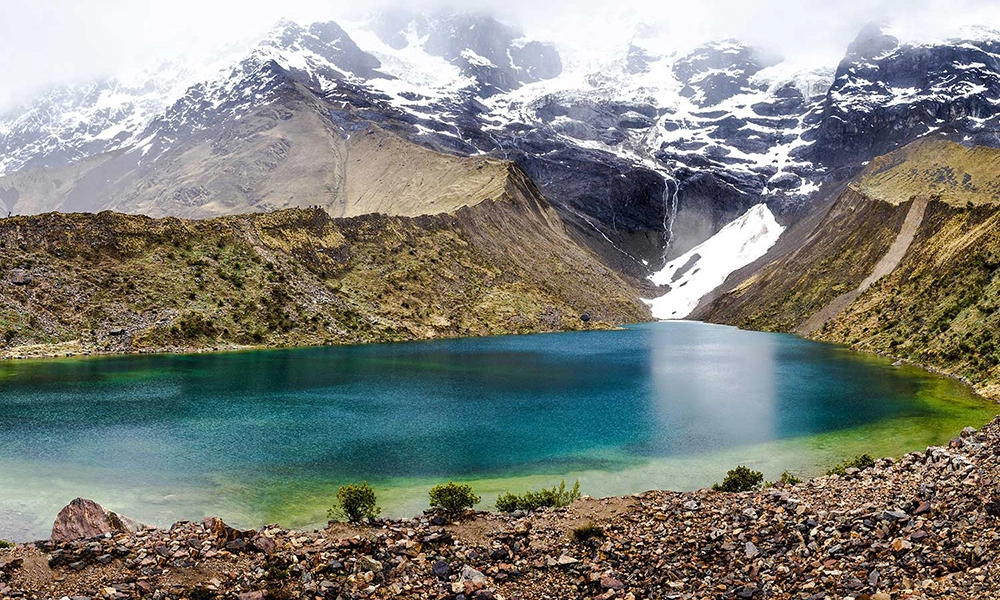
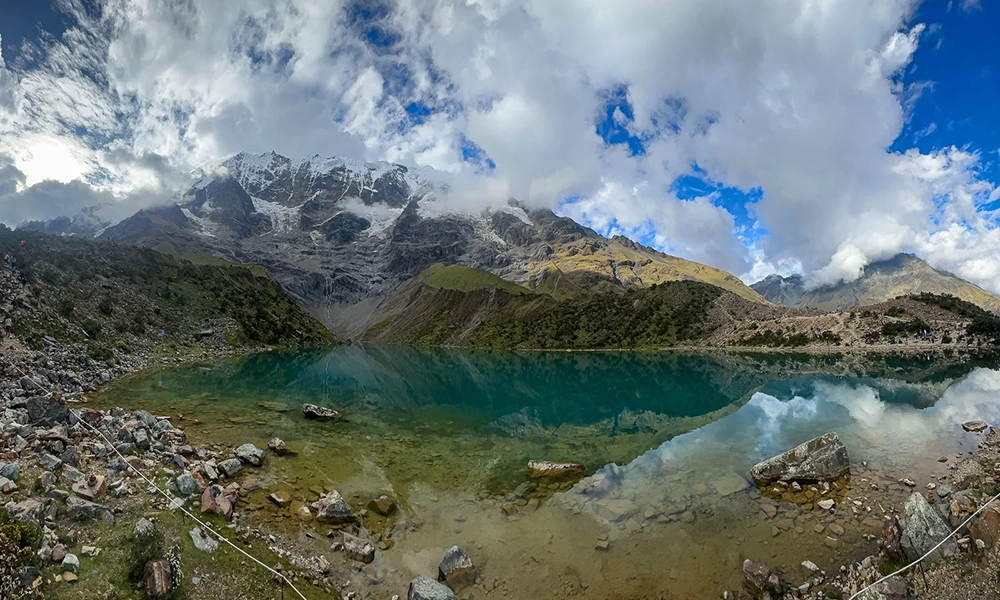
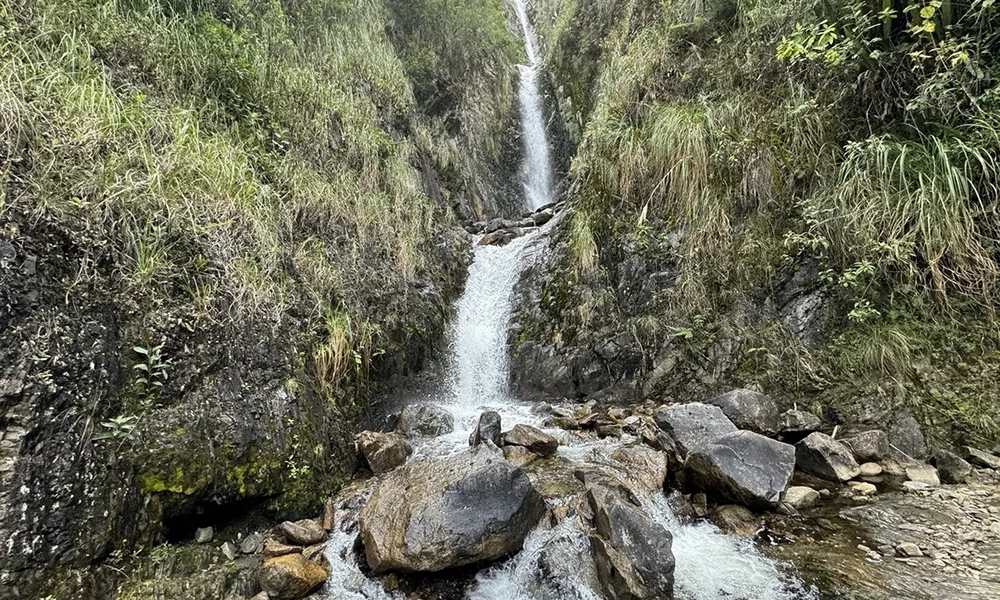
The Salkantay Trek is one of the most spectacular trekking routes in South America. Along its nearly 70 km, travelers traverse glaciers, rocky gorges, Andean valleys, cloud forests, and high jungle.
But among all the natural treasures along the way, two stand out for their magic:
the waterfalls—springing from the melting snow of the Apus (mountain spirits)—and the viewpoints, from where the landscape unfolds like a sacred book.
This guide brings together, in depth and with a poetic touch, all the most beautiful waterfalls and viewpoints of the Salkantay Trek, explaining where they are, how to get there, what they represent, and why each one is an essential piece of the journey to Machu Picchu.
🏔️ 1. Understanding the Salkantay Landscape: A World of Water, Rock, and Wind
Before exploring each waterfall and viewpoint, it’s important to understand something essential:
The Salkantay is a breathing ecosystem.
A sacred mountain (Apu) that feeds rivers, lagoons, and waterfalls with its own meltwater.
The climate changes dramatically in just a few hours:
- In the highlands, glacial cold reigns.
- In the mid-altitude zone, the cloud forest appears, filled with waterfalls.
- In the cloud forest, the humidity creates verdant walls and rushing rivers.
That’s why trekking is a journey through different worlds, where waterfalls multiply and viewpoints reveal the grandeur of the Andes.
🌬️ 2. The best waterfalls on the Salkantay Trek
💧 2.1 Soraypampa Waterfall: the prelude to the sacred mountain
Location: Day 1 – Very close to the lodges and campsites.
What makes it special:
- It originates from the meltwater of Nevado Humantay.
- You encounter it before ascending to the lagoon, like a gentle invitation.
- Its flow is gentle in the dry season, but powerful during the rainy season.
This is the first sign that Salkantay is a territory governed by pure and sacred water.
💧 2.2 Salkantaypampa Valley Waterfall
Location: Day 1, on the way to base camp before the pass.
Characteristics:
- Medium-sized waterfalls that form on the left side of the valley.
- They are visible from the trail and are known for their deep sound, which accompanies the hike.
- During the rainy season (January–March), they multiply and form silvery threads.
Why it’s important:
It’s a reminder of the glacier’s power and the transition to the upper reaches of the Apu (mountain spirit).
🌧️ 2.3 Wayracmachay Waterfall: The Voice of the Wind
Location: Day 2, after descending the Salkantay Pass.
This waterfall is one of the most impressive and memorable of the entire trek.
What makes it unique:
- It marks the beginning of the descent into the rainforest.
- Its fall is powerful due to the slope and the volume of the river.
- The sound can be heard from afar, mingling with the whistling of the wind (“wayra” in Quechua).
- In the rainy season, it creates mists that lend a magical touch to the trail.
Ideal photo spot:
From the bend where the trail turns south.
There, the view encompasses the entire valley, the waterfall, and the open sky.
🌿 2.4 The Multiple Waterfalls of the Cloud Forest
Location: Between Chaullay, Collpapampa, and Sahuayaco Beach (days 2 and 3).
There isn’t just one famous waterfall here.
There are dozens.
Why they are so special:
- They originate from springs in the cloud forest.
- Some cross the trail, creating small natural bridges.
- Others plunge from great heights and disappear into the vegetation.
- During the rainy season, the entire mountain literally transforms into a waterfall.
Ecological Importance:
- They maintain the valley’s humidity.
- They provide refuge for birds, water-loving plants, and orchids.
Tips:
- Bring a waterproof poncho.
- The humidity is constant.
🌩️ 2.5 Santa Teresa River Waterfall
Location: Day 3 or 4 (depending on the itinerary).
Although not on the main trail, it is visible from Playa or from the road to Lucmabamba.
Characteristics:
- Much larger and more voluminous than the previous waterfalls.
- Its power can be impressive: it originates from Andean snowmelt and the flow of several jungle streams.
Why it’s worth it:
It is the first sign of the young Amazonian rivers that will later feed the Urubamba River.
🏞️ 3. The Best Viewpoints on the Salkantay Trek
The viewpoints on the Salkantay are not just high points:
they are ceremonial sites, spaces where the mountain reveals itself in all its grandeur.
❄️ 3.1 Salkantaypampa Viewpoint
Location: Day 1.
View:
- Open valley, with a direct view of Nevado Salkantay.
- Contrast between tall grasses, rocks, and sky.
The feeling:
This is where the Apu (mountain spirit) reveals itself for the first time.
Your gaze is lifted, and silence reigns.
Ideal for:
- Short meditation
- Wide-scale photos
- Contemplating the route ahead
❄️ 3.2 Salkantay Pass Viewpoint (4,630 m): the sacred point
Location: Day 2 – The highest point of the trek.
View:
- The icy face of Nevado Salkantay.
- The hanging glacier.
- The valley you just climbed and the one you’re about to descend.
- Black mountains, immense sky, icy wind.
Here the wind has a voice. It doesn’t blow: it recites.
It’s the spot where many travelers leave stones as a symbolic offering to the Apu (mountain spirit).
Tips:
- Don’t stay too long: the cold is intense.
- Take a panoramic photo.
- Stay hydrated.
🌫️ 3.3 Huayracmachay Valley Viewpoint
Location: Start of the descent after the pass.
View:
- A deep valley shrouded in clouds.
- The newly formed river winding below.
- Green mountains emerging from the background.
Why it’s special:
It’s the first glimpse of the transition between the Andean and Amazonian worlds.
🌿 3.4 Cloud Forest Viewpoint
Location: Between Collpapampa and Lucmabamba.
Intense view:
- Endless layers of green mountains.
- Mist drifting in and out as if the earth were breathing.
- Sounds of hidden birds.
Here, the air changes texture.
It becomes humid, fragrant, alive.
🏛️ 3.5 Llactapata Viewpoint: The Place Where Machu Picchu Appears
Location: Day 4 (or Day 5 depending on the itinerary).
This viewpoint is unique for three reasons:
- You see Machu Picchu for the first time, from a sacred angle, not from the modern entrance.
- It’s next to the Inca ruins of Llactapata, an ancient observation post.
- The afternoon light falls directly on the citadel.
Emotional Experience:
Many travelers cry here without knowing why.
It’s the emotion of achieving a goal,
mixed with the pure beauty of the jungle,
plus the ancient history of the Qhapaq Ñan (Inca Road).
Recommendation:
Arrive between 3:00 and 4:00 p.m.
The light is perfect.
📸 4. The best photo spots on the Salkantay Trek (by day)
🌿Day 1:
- Soraypampa Waterfall
- Salkantaypampa Viewpoint
🌫️Day 2:
- Abra Viewpoint
- Wayracmachay Waterfall
- Valley Gorges
🏛️Day 3:
- Cloud Forest Waterfalls
- River Crossing and Orchids
❄️Day 4:
- Llactapata Viewpoint
- Jungle Mountains on the way to the Hydroelectric Plant
🏞️Day 5:
- Trails between Aguas Calientes and Machu Picchu
- View of Huayna Picchu at sunrise
🧭 5. Tips for enjoying waterfalls and viewpoints
📷 Bring extra batteries: the cold drains them quickly.
🧥 Always wear a waterproof jacket: waterfalls increase humidity.
🥾 Boots with good traction: wet areas can be slippery.
☔ Dry season = fewer waterfalls, better views.
🌧️ Rainy season = gigantic waterfalls, abundant fog.
🕐 Sunrise and sunset = best light for photography.
🌟 Salkantay as a map of water and altitude
The Salkantay Trek is more than a path to Machu Picchu.
It is a sensory journey, a ritual, an intimate conversation with the mountain range.
In its waterfalls, you find the liquid energy of the Apus (mountain spirits).
At its viewpoints, you find the silent wisdom of the Andes.
In its changing weather, you learn that everything in life flows.
Those who travel this route don’t just walk… they are transformed.