

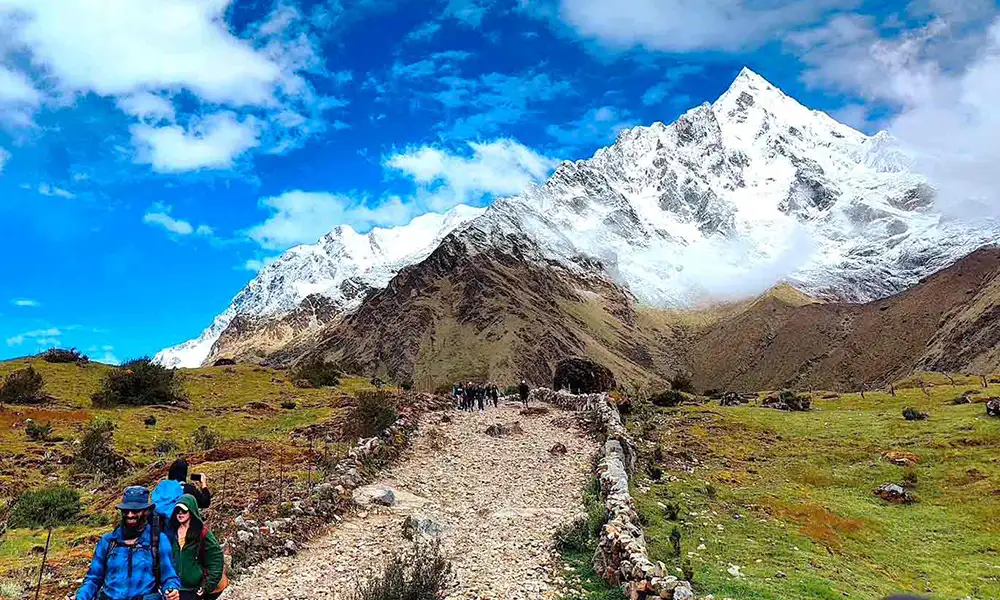
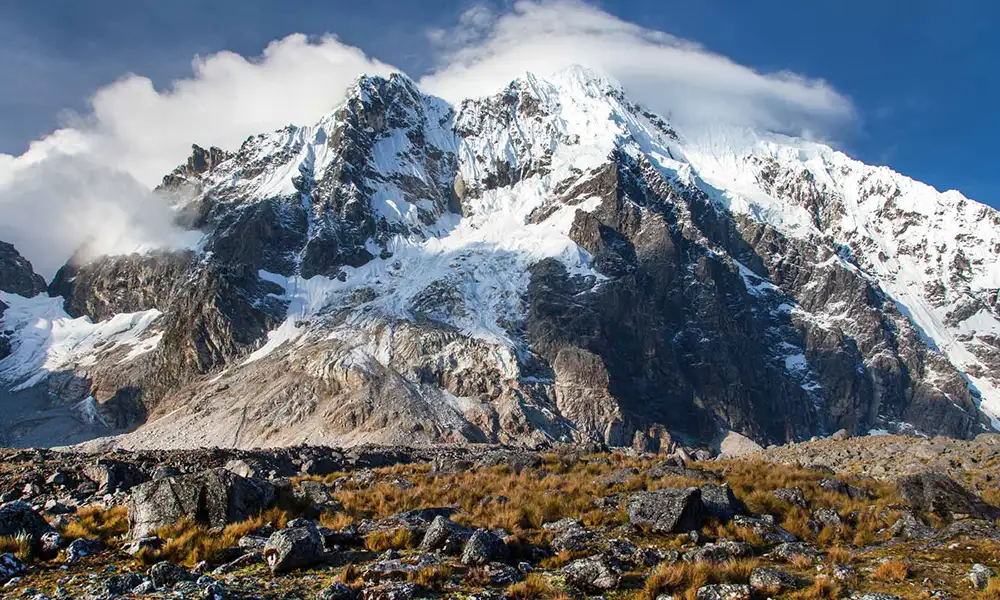
Some trails are remembered for their views.
Others for their challenges.
The Salkantay Trek, however, is remembered for its voice.
A trail where the mountain is not just a landscape:
it is a living being that breathes, sings, roars, falls silent, and embraces.
This blog is a sonic journey.
A guide to understanding what the ear perceives, what the heart translates, and what the spirit retains.
Because the Salkantay is not just walked:
it is listened to.
🏔️ 1. The sound geography of the Salkantay: an auditory map of the trail
Each ecosystem along the trek generates a distinct “acoustic universe.”
The sounds don’t appear randomly: they respond to the altitude, the terrain, the climate, the wind, the water, and the type of vegetation.
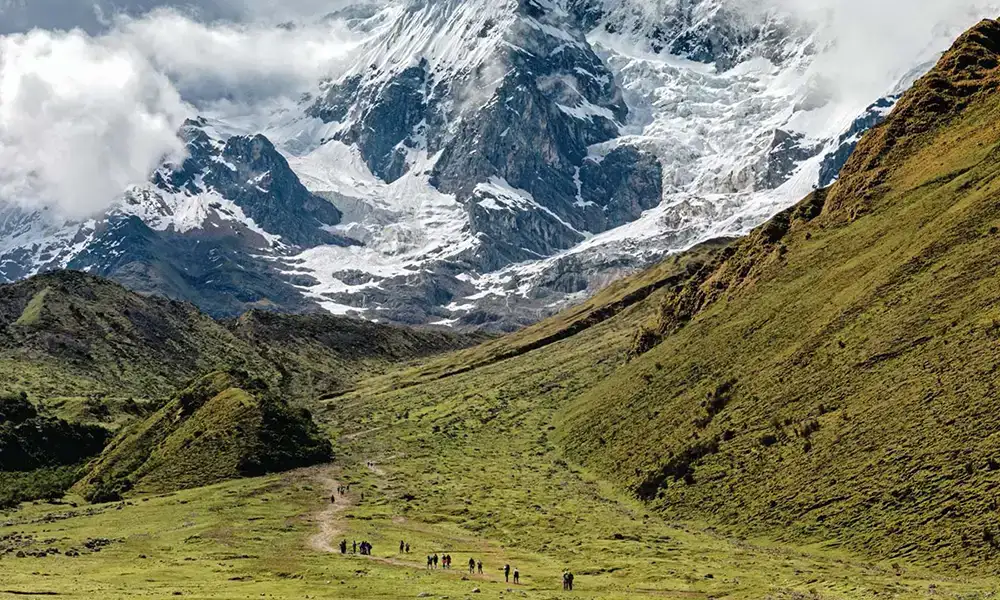
Glacial puna (3,900 – 4,630 m):
Cold, clean, powerful sounds.
The air is thin, the noises travel far.
Wind, echo, and silence predominate.
High ravine (3,500 – 3,900 m):
Young rivers, cool waterfalls, rocks that amplify the vibrations.
The water here seems to sing in its own language.
Cloud forest (2,900 – 3,500 m):
Soft, round, humid sounds.
Hidden birds, sighing leaves, fine rain weaving a rhythm.
High jungle (2,000 – 2,800 m):
Birdsongs, electric insects, multiplying streams.
A tropical orchestra under the mist.
Each section is a resonating chamber.
Each day of the trek has a “sound chapter.”
🌬️ 2. The wind of Apu Salkantay: the oldest sound of the Andes
The wind on this mountain is not wind.
It is word, it is presence, it is oracle.
The Quechua people call it wayra,
and consider it a messenger between humans and the Apus (mountain spirits).
Types of wind you will hear:
- Fine whistles that filter through the stone.
- Long howls that advance through the valleys like invisible felines.
- Violent gusts that seem like warnings or tests.
- Gentle breezes in the lower areas that caress without haste.
At the Salkantay Pass (4,630 m), something unique happens:
the wind “changes tone” depending on the time of day:
- at dawn: a metallic, rising sound
- at midday: a steady roar
- in the afternoon: irregular vibrations
- at dusk: a deep whisper
It is as if the Apu had moods.
💧 3. Living Water: Salkantay as a Mountain that Pulses
Salkantay is a mountain of water.
70% of the sounds on the trek come from water:
- drip-drip,
- stream,
- thread,
- rivers,
- torrents,
- waterfalls,
- rain,
- microglacial falls.
Key soundscapes:
❄️ Salkantaypampa
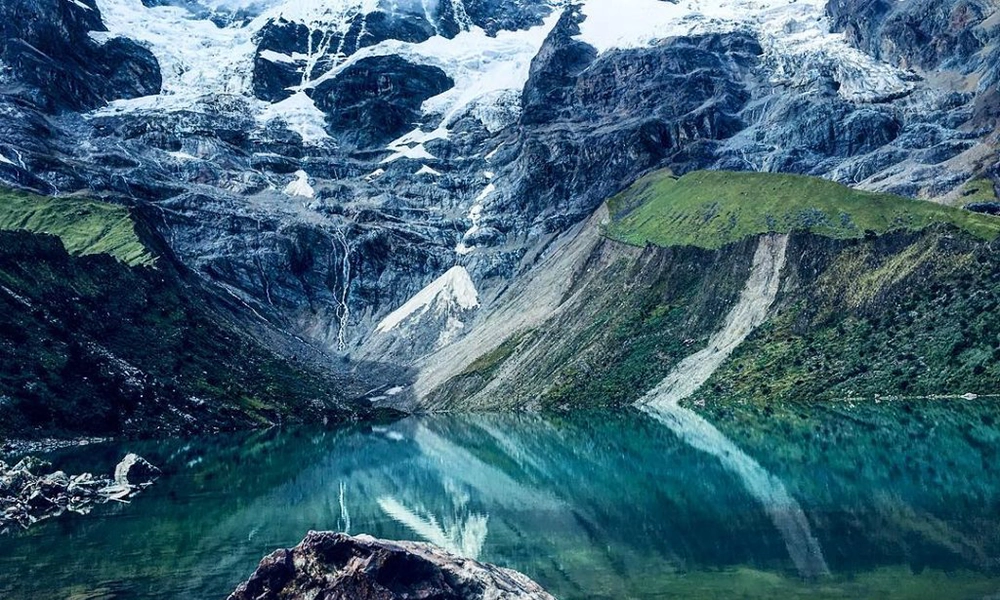
Water born from the moraine.
It sounds pure, delicate, like shattering glass.
🌊 Wayracmachay
Here the water falls with force because the slope intensifies.
The waterfalls generate “low notes” that echo off the valley walls.
🌿 High Jungle: Collpapampa → La Playa
The water no longer sounds cold.
Now it murmurs, envelops, caresses.
It is more mature, more expansive, more alive water.
Technical note:
The difference in sound is due to the temperature, the flow rate, and the type of rock.
In the high Andean plateau, water falls on hard rocks → high-pitched sounds.
In the rainforest, on earth and vegetation → warm sounds.
⛰️ 4. Silence as the protagonist: the sound that moves you most
At the heights of Salkantay, there is a silence you won’t find in cities, beaches, or Amazonian reserves.
It’s a silence with a physical presence.
A silence that stops you, listens to you, envelops you.
This silence is especially noticeable:
- before dawn,
- facing the snow-capped peak,
- leaving Soraypampa,
- at the mountain pass,
- after the snow falls,
- and when the wind suddenly dies down.
Why is it so powerful?
Because it leaves you alone with:
- your breath,
- your thoughts,
- your effort,
- your vulnerability,
- your inner strength.
Many travelers cry here.
Not from sadness, but because the silence opens something deep within them.
🥾 5. Human Footsteps: The Sound of Effort and Willpower
Trekking is also a human symphony.
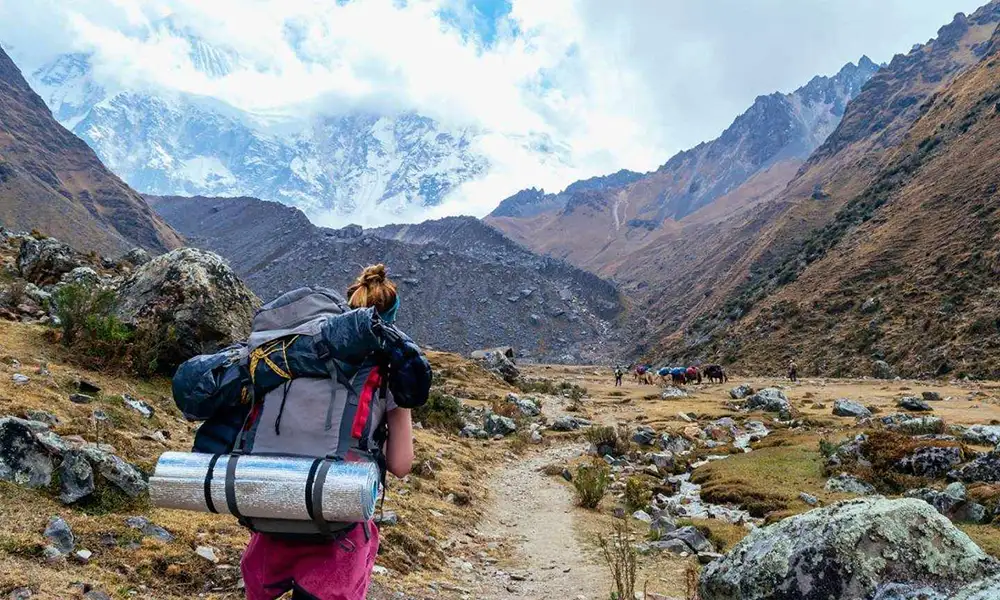
The sound of your footsteps changes with altitude, terrain, and fatigue.
The terrain of Salkantay and its characteristic sounds:
- Glacial gravel → metallic creaks.
- Fine sand → muffled noise.
- Loose stones → dry cracks.
- Damp leaves → soft whispers.
- Jungle mud → muffled sounds.
- Large rocks → faint echo.
Trekking poles add their own rhythm:
a tap-tap-tap that sometimes synchronizes with your heartbeat.
Breathing also becomes music:
pants, pauses, deep inhalations.
It is the dialogue between body and mountain.
🌳 6. The Cloud Forest: A Green Acoustic Temple
This is one of the most beautiful soundscapes.
Here, the mountain “speaks softly.”
Sounds of the forest:
- droplets falling from the foliage, even when it’s not raining
- birds with delicate echoes
- insects that vibrate like taut strings
- branches moving without any visible origin
- small, hidden streams
The humidity absorbs the noise, so everything sounds close and warm, as if whispering in your ear.
In this section, many travelers feel that “someone is accompanying them.”
Perhaps the jungle, perhaps the Apu (mountain spirit), perhaps the trek itself.
🦜 7. The High Jungle: A Vibrant Concert of Life
As the route descends towards Collpapampa, the high jungle opens up a soothing world
Explosive sound.
You will hear:
- the deep grrrr of the Santa Teresa River,
- the tsst-tsst of insects,
- the pi-pi-piííí of hummingbirds,
- the crackle of leaves breaking under animals,
- the rapid bubbling of small rivers,
- the to-to-to of raindrops falling on enormous leaves,
- the long roar of the wind trapped in dense branches.
It is a living, intense, present environment.
Here, your hearing awakens and expands.
🔥 8. Human sounds of the camp: the social life of the trek
Salkantay also has warm, human, familiar sounds.
🧭In Soraypampa and Salkantaypampa:
- travelers laughing nervously
- guides telling stories in Quechua and Spanish
- pots clinking
- Andean dogs barking
- mules snorting
🌟In Collpapampa and Sahuayaco Beach:
- nighttime conversations
- soft music from peasant kitchens
- weary shuffling footsteps
- whispers about the day’s experiences
🌌In Lucmabamba:
- crickets
- roosters crowing
- voices from farms
- the crackling of campfires
Human life completes the soundscape of the trek.
🌌 9. Night in the Mountains: Sounds You’ll Never Forget
When night falls, everything changes.
The sound becomes deeper, slower, more mysterious.
You can hear:
- the wind descending from the glacier like an ancient breath
- rivers sounding louder in contrast to the silence
- the distant footsteps of mules or horses
- drops of water hitting the tents
- the creaking of ice
- the long, drawn-out calls of nocturnal insects
- the murmur of travelers conversing in different languages
Sometimes, if you listen closely, you can hear a magical sound:
the ice moving.
A deep, almost imperceptible creak that announces the glacier is alive.
🧘 10. The spiritual experience of sound: why this trek transforms
The Quechua people say that the loudest sound on Salkantay is the one that goes unheard:
the one that stays within.
Many travelers explain that this route left them with:
- mental clarity,
- peace,
- body awareness,
- connection with the mountain,
- a feeling of having been heard.
Why?
Because the sounds of Salkantay soothe the soul.
They align something within.
They bring you back to your presence.
🧭 11. Practical Guide: How to Better Appreciate the Sounds of the Trek
✔ Walk without music
The Salkantay already has its own.
✔ Take “mindful listening pauses”
Stop for 1 minute every hour.
✔ Close your eyes facing the snow-capped mountain
The wind becomes more powerful.
✔ Record short audio clips
They will serve as emotional memories.
✔ Ask your guide
They distinguish sounds that you might not notice: birds, plants, rivers, changes in the weather.
🌟The Salkantay is not walked, it is listened to
The Salkantay Trek is a profound sound journey:
a blend of ancient wind, newborn water, sacred silence, human voices, vibrant jungle, and nights that whisper stories.
Every sound along the way is a page in a book the mountain has been writing for thousands of years.
And when you arrive at Machu Picchu,
when it all ends…
there is a sound that stays with you for years:
the echo of Apu Salkantay within your heart.
That echo never fades.