

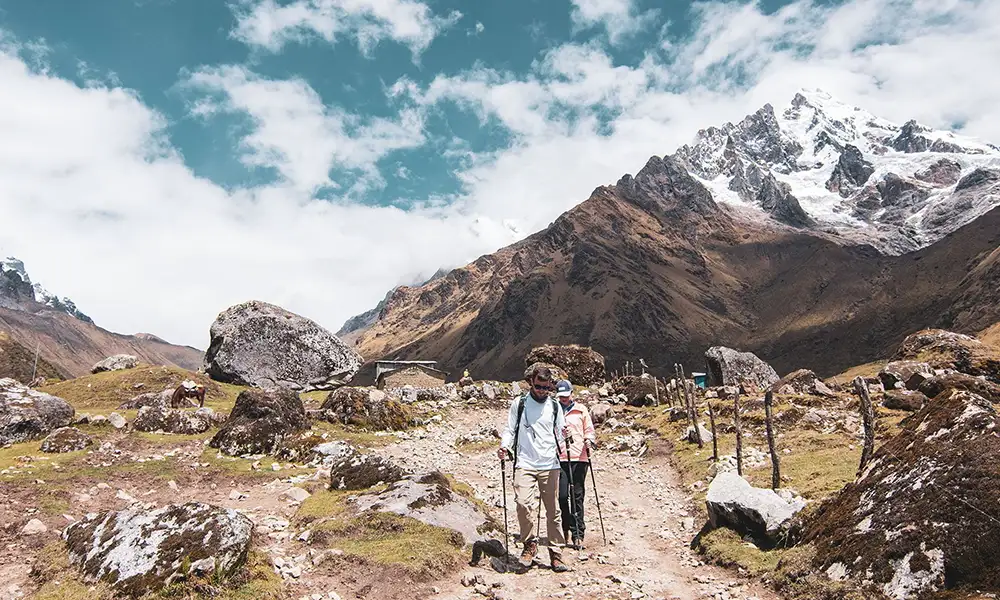
Salkantay Trek Day-by-Day Altitude Guide: How Does Altitude Affect Your Adventure?
🌄 Altitude, Andes, and Personal Challenge
The Salkantay Trek is one of the most spectacular and demanding treks in Peru. It stands out not only for its landscapes—which change dramatically from glaciers to Amazon rainforest in a single trip—but also for its intense elevation gain, which tests body, mind, and endurance.
From 3,400 meters in Cusco to 4,630 meters at the legendary Salkantay Pass, this trek takes you through high-altitude terrain where oxygen levels decrease, the weather becomes unpredictable, and your body needs to adapt to fully enjoy the experience.
This guide is the most complete and detailed resource on the altitude of the Salkantay Trek, explained day by day, with professional advice, real symptoms of altitude sickness, acclimatization recommendations, and strategies to overcome the challenge.
Get ready to understand the heart of the trek: altitude.
🗺️ 1. Exact Altitudes of the Salkantay Trek by Day
Here’s the most accurate breakdown, based on real data used by trekking agencies.
⭐ Day 1: Cusco → Mollepata → Soraypampa → Humantay Lagoon
- Cusco: 3,400 m
- Mollepata: 2,900 m
- Soraypampa (camp): 3,900 m
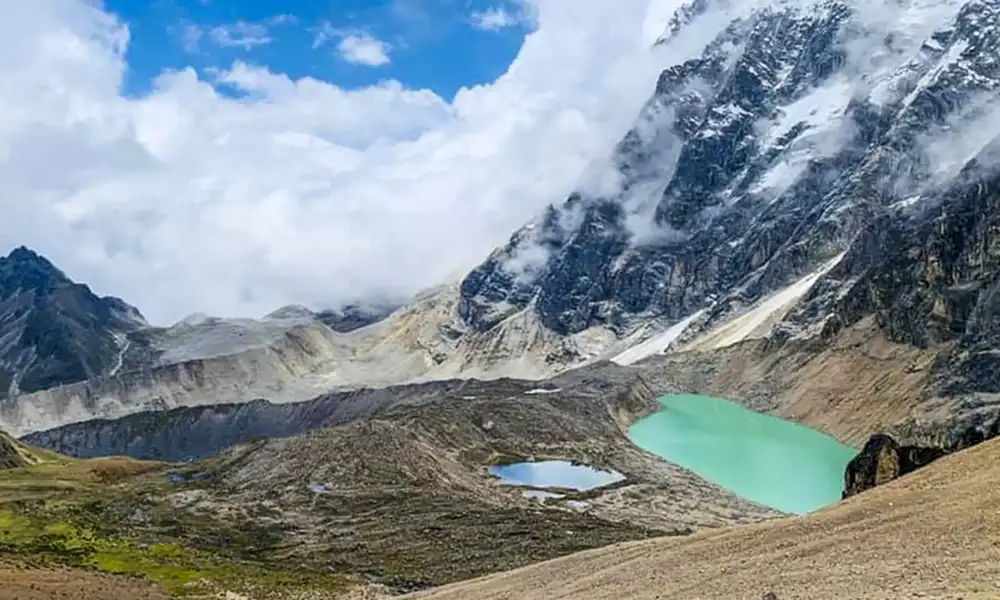
- Humantay Lagoon: 4,200 m
🧠 What does this altitude mean for your body?
The first day is a direct shock to the altitude. You go from 3,400 m to almost 4,000 m in just a few hours.
🔍 What you’ll likely feel:
- Heavier breathing
- Slight headache
- Fatigue on the climb to the lagoon
- Cold that intensifies at nightfall
🔥 Tips for the day:
- Hydrate before the hike to Humantay
- Drink coca tea upon arrival at Soraypampa
- Avoid overexertion: walk at your own pace
Note: Sleeping at 3,900 m is one of the most intense moments of the trek.
⭐ Day 2: Soraypampa → Salkantay Pass → Huayracmachay → Chaullay
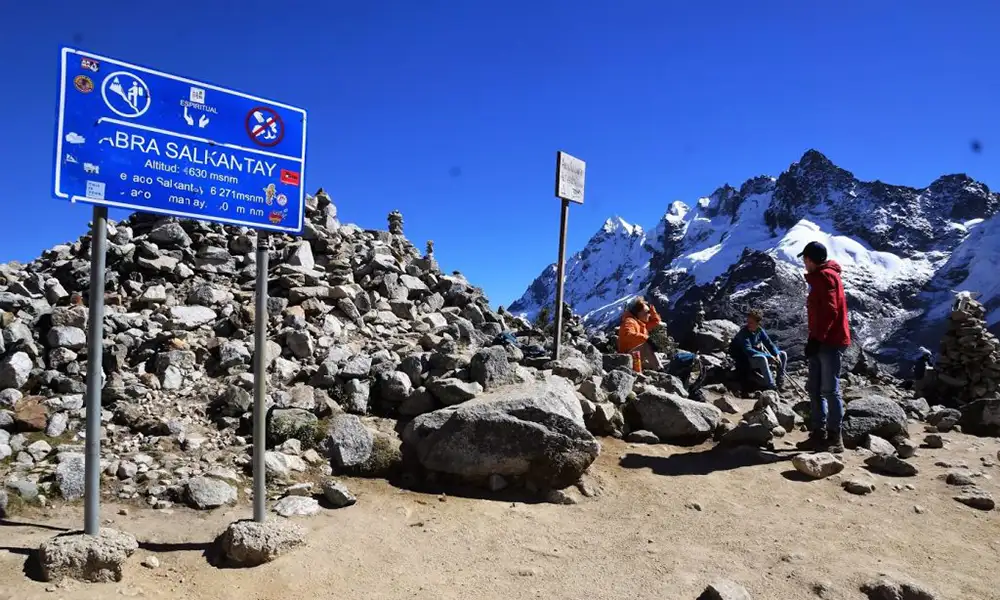
- Salkantay Pass (highest point): 4,630 m
- Huayracmachay: 3,900 m
- Chaullay (camp): 2,900 m
🌬️ The Most Difficult Day: “The Day of Apu Salkantay”
This is the most demanding section of the trek.
You climb almost 700 meters from Soraypampa to Salkantay Pass on a cold, windy route with low oxygen.
🔍 What you will feel:
- Difficulty breathing on the ascents
- Need for more frequent rest
- Icy wind near the pass
- More intense heart palpitations
😮 Why such a difference?
Because you are hiking in an area of moderate hypoxia, where oxygen levels are reduced by up to 40%.
🍃 Then it gets better:
As you descend towards Chaullay, your body receives more oxygen and your energy returns.
⭐ Day 3: Chaullay → La Playa → Lucmabamba
- Chaullay: 2,900 m
- La Playa: 2,100 m
- Lucmabamba (camp): 2,100 m
🧘 Natural Recovery Day
This day is a complete climatic transition:
From cold mountains → to warm, humid cloud forest.
What you’ll feel:
- Increased appetite
- Restful sleep
- Faster gait
- Improved mood
The altitude is no longer a problem. The humidity may cause heavy sweating, but breathing will be very easy.
⭐ Day 4: Lucmabamba → Llactapata → Hydroelectric Plant → Aguas Calientes
- Lucmabamba: 2,100 m
- Llactapata (view of Machu Picchu): 2,800 m
- Hydroelectric Plant: 1,900 m
- Aguas Calientes: 2,040 m
💚 Short but intense climb
The climb to Llactapata is surrounded by cloud forest and is steep, but being below 3,000 m, it doesn’t cause too many breathing problems.
What you’ll feel:
- Better energy
- A tropical climate feeling
- Constant sweating
- Tired feet from the last flat section
At the Hydroelectric Plant, the temperature can exceed 26°C.
⭐ Day 5: Aguas Calientes → Machu Picchu
- Aguas Calientes: 2,040 m
- Machu Picchu: 2,430 m
🌅 Final push: The ascent to Machu Picchu
At this altitude, oxygen is plentiful.
The fatigue you feel will be muscular, not from altitude.
🧭 2. Complete Altitude Map of the Salkantay Trek
Place Height (m.a.s.l.)
Cusco 3,400
Mollepata 2,900
Soraypampa 3,900
Humantay Lagoon 4,200
Abra Salkantay 4,630
Huayracmachay 3,900
Chaullay 2,900
The Beach 2,100
Lucmabamba 2,100
Llactapata 2,800
Hydroelectric 1,900
Aguas Calientes 2,040
Machu Picchu 2,430
Perfect for Featured Snippets.
👣 3. How Altitude Affects the Body on the Salkantay Trek
Altitude creates a condition called “hypoxia,” meaning less oxygen is available to your body.
1. Mild (normal) symptoms:
- Mild headach
- Shortness of breath
- Fatigue
- Loss of appetite
- Mild nausea
2. Moderate symptoms:
- Dizziness
- Persistent headache
- Rapid heartbeat
- Insomnia
3. Warning signs:
- Severe vomiting
- Loss of balance
- Mental confusion
- Severe shortness of breath
If this occurs, you must descend immediately and notify your guide.
🌟 4. Why is the Salkantay Pass so high? (The real explanation)
Apu Salkantay is one of the most sacred snow-capped mountains in Cusco.
The original route used by the Incas crossed this pass because it was the most direct path to Vilcabamba and Machu Picchu.
That’s why modern trekking crosses to:
📍 4,630 meters above sea level,
making it one of the most impressive high points in Peru and South America.
🧴 5. How to Acclimate Your Body to Altitude Before the Trek
✔️ Arrive in Cusco 48–72 hours beforehand
Ideally: 3 full days.
✔️ Avoid alcohol, heavy meals, and fried foods
Digestion slows down at high altitude.
✔️ Drink 2–3 liters of water a day
Hydration is key to reducing symptoms.
✔️ Walk slowly around Cusco
Climb to Sacsayhuamán, viewpoints, or San Cristóbal.
✔️ Coca and muña tea
Helps stabilize breathing.
✔️ Eat carbohydrates
They are your main source of energy at altitude.
🧭 6. Professional Tips for Overcoming Altitude on the Salkantay Trek
💡 1. Use trekking poles on ascents
They reduce the effort required to breathe.
🍫 2. Carry energy snacks
Chocolate, nuts, or protein bars.
🐢 3. Move slowly through the Salkantay Pass
The first 200–300 meters near the pass are the hardest.
💨 4. Breathe deeply
Inhale through your nose, exhale through your mouth.
👟 5. Wear good footwear
A bad step at altitude hurts twice as much.
🎒 6. Keep your backpack light
Only the essentials: 3–5 kg maximum.
🧡 7. Have a positive attitude
Your mindset is crucial on the day of the abra.
🌤️ 7. How the Climate Changes with Altitude
The trek passes through three ecosystems:
❄️ High mountain (3,900–4,630 m)
- Temperatures: -5°C to -10°C
- Strong winds
- Risk of hail
- Reduced oxygen
🌿 Cloud forest (2,900–2,000 m)
- Temperature: 15°C – 24°C
- High humidity
- Mosquitoes
- Dense forests
🌳 High rainforest (2,000–1,900 m)
- Temperature: 18°C – 27°C
- Frequent rain
- Rivers, waterfalls, and tropical vegetation
🏔️ 8. What Makes Salkantay Unique in terms of Altitude?
Unlike other treks such as:
- Lares
- Ausangate
- Huchuy Qosqo
- Inca Trail
The Salkantay combines a single day of extreme altitude followed by a gradual descent into the rainforest, making it:
- More varied
- More complete
- More balanced
It’s not just a climb:
It’s a journey through the Andes, the cloud forest, and into the Amazon.
🌟Conclusion
The Salkantay Trek is a unique high-altitude challenge, as demanding as it is beautiful. Its extreme heights, especially the crossing of the Salkantay Pass, will test your endurance, but also offer some of the most breathtaking views of your life.
With proper preparation, acclimatization, and by following this detailed guide, you’ll be ready to enjoy the route safely and have an unforgettable experience among sacred mountains, vibrant lagoons, and ever-changing landscapes.
The altitude is a challenge, yes, but it’s also part of the magic of the Salkantay. 🏔️✨