

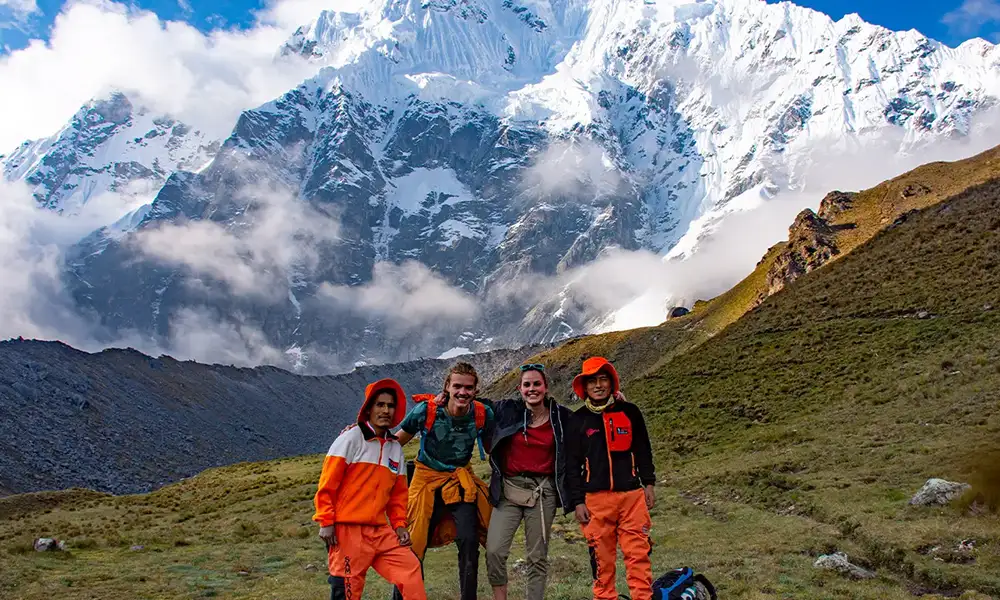
The Ultimate Guide to the Salkantay Trek
Some tools are designed to help you; others, to transform you. Trekking poles belong to both categories.
They are silent extensions of your arms, compasses for your balance, guardians of your knees, metronomes of the trail.
Those who learn to use them walk farther.
Those who master them walk better.
But those who feel them as part of their body walk with their soul.
This is a comprehensive manual—technical and profound, practical and poetic—that teaches you not only how to use trekking poles, but also how to interpret their rhythm on one of the most challenging and beautiful routes in Peru: the Salkantay Trek.
🌄 1. The Spiritual and Physical Purpose of the Poles
On a route like Salkantay, where the wind takes your breath away and the mountain roars in silence, every step is an act of will. Trekking poles aren’t there to take the work out of your way:
they’re there to teach you a different way of walking—smarter, smoother, more harmonious.
Their true purpose:
- To reduce joint pressure by up to 30%.
- To provide balance where gravity tries to pull you into the void.
- To distribute the effort between your arms and legs.
- To prevent injuries to your knees, hips, and ankles.
- To improve your posture, preventing you from hunching over due to altitude or weight.
- To help you ascend steadily, without unnecessary fatigue.
- To provide emotional security, because in the mountains, your mind weighs as much as your backpack.
But beyond biomechanics, they teach you something more:
to walk without rushing, without clumsiness, without fear… with awareness.
📏 2. Adjusting the pole height: the science behind comfort
A poorly adjusted pole is like a poorly spoken word:
it throws you off balance.
- Adjustment for flat terrain:
- Your elbow should be at exactly 90°.
- Technical formula:
Your height × 0.67 = pole height.
- Adjustment for ascents (like towards Soroycocha or the Salkantay Pass):
- Shorten them by 5–10 cm.
- This allows you to keep your chest open and your lungs functioning properly in the limited oxygen.
- Adjustment for descents (like towards Huayracmachay):
- Lengthen them by 10–15 cm.
- You’ll need the poles further away to cushion the impact.
- Adjustment on technical terrain:
- Intermediate height.
- Change quickly.
- Be adaptable.
- Salkantay demands it.
In the mountains, nothing is rigid;
everything is about adjustment, adaptation, and communicating with the terrain.
✋ 3. The correct wrist strap technique: where efficiency begins
The wrist strap is the professional secret of every experienced hiker.
Most people use them incorrectly.
But when you use them correctly… the poles carry you.
Official (and correct) technique:
- Insert your hand from the bottom of the strap upwards.
- Grab the handle with the strap resting between your palm and the grip.
- Adjust so that your wrist supports the weight, not your fingers.
Why does it work?
- It gives your fingers a rest.
- It prevents blisters.
- It distributes weight better on long descents.
- It reduces fatigue on hikes longer than 5 hours.
The wrist strap is the bridge between your energy and the trekking pole.
If you master it, your arms become wings.
🥾 4. Walking with poles: the dance of the cross-step
The most natural technique is also the most ancient: the cross-step.
- Right pole → left foot
- Left pole → right foot
It’s the rhythm of the human body since we learned to walk upright.
Golden rules of perfect movement
- The pole should fall slightly in front of your foot.
- Don’t plant it too hard; Support it with intention.
- Keep your shoulders relaxed.
- The movement should be fluid, silent, and constant.
- Never use the poles as crutches.
- Never pull them too far back: you lose momentum.
The correct sound of the pole is not a thud,
but a sigh against the ground.
🧗♂️ 5. Technique for ascents (when your chest burns)
Climbing towards the Salkantay Pass, at 4,630 m, is a humbling experience.
Your body struggles, air is scarce, your heart beats like a sacred drum.
The poles should help you, not hold you back.
Ascent technique:
- Shorter poles.
- Plant them close to your body.
- Push off slightly backward.
- Short, very short steps: conserve oxygen.
- Keep your gaze on the immediate terrain.
- Don’t lean your torso too far forward; it cuts into your air.
Climbing is a dialogue between your will and altitude sickness.
Trekking poles are your translators.
🏞️ 6. Technique for descents (when the world tilts)
Long descents on Salkantay can wreck untrained knees.
Professional technique:
- Longer poles.
- Always plant your foot before putting it down.
- Keep your torso slightly back.
- Avoid sudden jumps.
- Maintain a steady pace.
On descents, your poles are your brakes,
your shock absorber,
your guardian.
🪨 7. Trekking poles on technical terrain
Each type of terrain demands a different approach:
On large rocks
Only place your pole on firm rocks.
Avoid those that vibrate.
In mud
Plant your pole deeper to avoid slipping.
In sand or loose soil
Perpendicular angle.
Not lateral.
In light snow
Pit harder and use wide baskets.
In rivers and wet sections
Treat poles are your third and fourth foot.
Use them before
Your boots.
🚫 8. Common Mistakes to Avoid
- Planting the pole too far forward.
- Putting all your weight on the poles.
- Forgetting to adjust the height.
- Not using the wrist straps correctly.
- Standing on loose rocks.
- Walking with stiff arms.
- Poles that are too short or too long.
- Not folding them in narrow sections.
A repeated mistake in the mountains can lead to injury.
🎒 9. Recommended Use for the Salkantay Trek
Use trekking poles on:
- Day 1 → Ascent to Humantay
- Day 2 → Salkantay Pass and descent to Huayracmachay
- Day 3 → Wet sections in the cloud forest
- Day 4 → Llactapata
- Day 5 → Long section towards the Hydroelectric Plant
Store them in:
- Narrow passages
- Rocky steps
- Paths along precipices
🌬️ 10. The Poetic Aspect: Trekking Poles as Travel Companions
In the silence of the mountains,
when the icy wind of Salkantay whistles through the glaciers,
your trekking poles are your confidants.
With each gentle tap—tap, tap, tap—
you hear your breath align
and your heart find its rhythm.
They are metronomes of your strength,
witnesses to your endurance,
guardians of your balance.
Trekking poles are more than just equipment:
they are the echo of your will as you walk.
🌄 Walk with intelligence, harmony, and purpose
Using trekking poles correctly is a blend of science and sensitivity.
Biomechanics, technique, posture, but also rhythm, intuition, and poetry.
Mastering the poles is mastering the path.
It’s walking farther, with more elegance, less fatigue, and greater presence.
On Salkantay, where the air is thin,
every step counts.